
When a water heater reaches the end of its life, it is tempting to replace the number on the old label with the same number—or simply buy a larger tank. A better choice starts with how your household actually uses hot water and what the installation area can safely support.
The short answer
A 30-gallon tank may fit a lower-demand household with limited installation space. A 50-gallon tank provides a larger stored supply for households that regularly use several showers or hot-water fixtures close together. But tank capacity is only one part of performance.
What a 30-gallon tank does well
- Fits more easily in compact closets and exterior enclosures.
- Can serve a household with modest, spaced-out hot-water use.
- Stores less water, which may reduce standby losses compared with a larger tank of similar efficiency.
- May be a practical replacement when the existing installation was designed around that footprint.
The tradeoff is a smaller reserve. Back-to-back showers or simultaneous laundry and bathing can use the available hot water faster than the heater can recover.
What a 50-gallon tank does well
- Provides more stored hot water during peak household demand.
- Better supports overlapping showers and appliance use when properly sized.
- Can reduce the likelihood of running cold during a busy morning or evening.
The tradeoffs are physical size, weight when full and the need to verify the enclosure, venting, combustion air, drain pan, seismic restraint and connections. A larger tank should not simply be squeezed into a space designed for a smaller one.
Four factors that matter more than gallons alone
1. First-hour rating
The first-hour rating estimates how much hot water a fully heated unit can deliver during a busy hour, combining stored capacity and recovery. Two 50-gallon models can perform differently. Compare the rating with your expected peak use, not only the tank label.
2. Recovery rate
Recovery is how quickly the heater can warm incoming cold water. Fuel type, burner or element capacity, incoming water temperature and efficiency all affect recovery. A unit with stronger recovery may handle repeated use better than capacity alone suggests.
3. The actual installation space
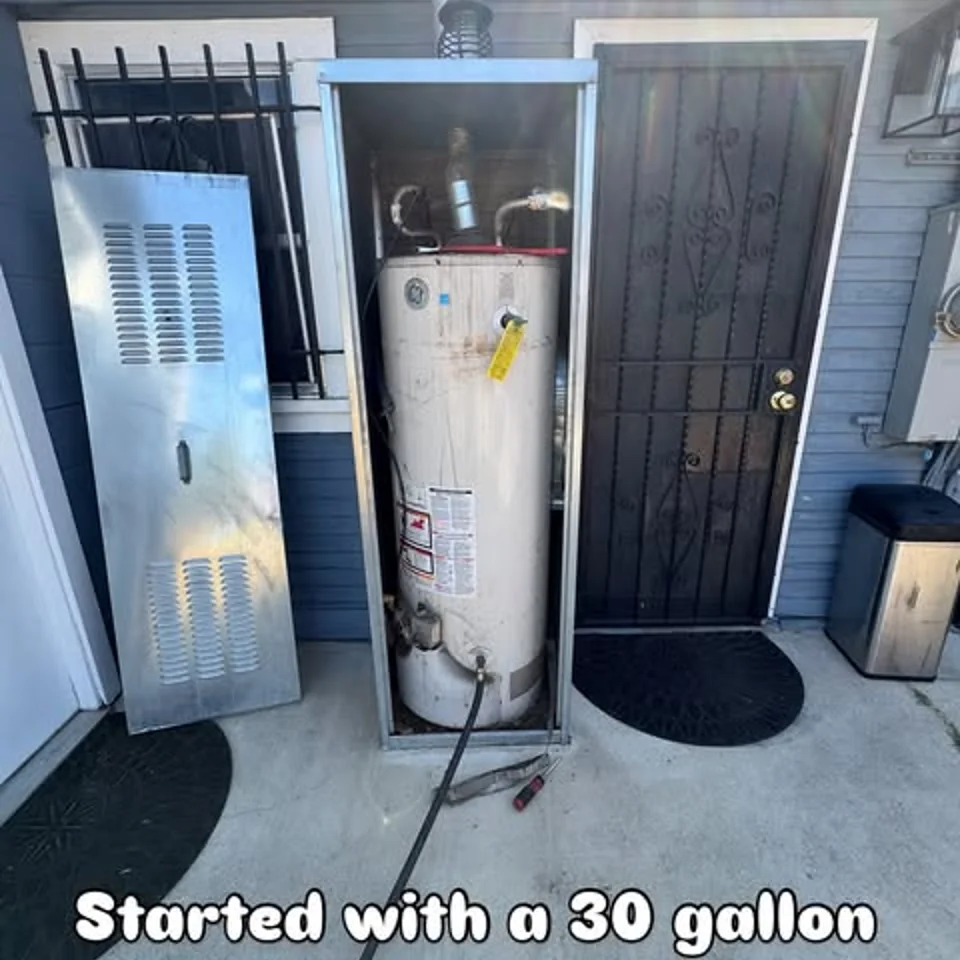
Measure width, depth and height, but also account for service access and connections. Exterior cabinets and older Los Angeles-area utility closets may require enclosure work when capacity changes. The documented R.G. Plumbing project above included replacing the enclosure to accommodate the larger tank.
4. Gas, electric or another system
The replacement must be compatible with the available energy source and the installation conditions. Gas units involve venting and combustion requirements; electric units depend on the electrical supply. A tankless system has different demand, fuel and installation considerations and should be evaluated as its own project.
Questions to answer before choosing
- How many showers happen back-to-back during the busiest hour?
- Do the dishwasher or washing machine run at the same time?
- Does the existing heater run out of hot water when operating normally?
- Can the enclosure safely fit and service a larger model?
- Is the energy source staying the same?
- Are there signs of leaking, corrosion or improper venting that must be corrected?
When replacement is more urgent
Active tank leakage, water around the base, visible corrosion at connections or repeated loss of hot water deserve prompt attention. If water is reaching electrical equipment, keep away from the area and call for professional help. A minor temperature or pilot issue may be repairable; a leaking tank generally is not.
Should you automatically replace the old size?
Not necessarily. If the old unit met demand and the household has not changed, a similar capacity may still make sense. If it regularly ran out—or if the household has added occupants, a soaking tub or higher simultaneous demand—recalculate. The installation area must be checked before the new unit is selected.
Planning a water heater replacement?
Share a photo of the existing heater, its label, the installation space and your household's peak hot-water pattern with R.G. Plumbing.